








How Early Should Makers Launch Their Christmas Collection?
Every year, the same question seems to sneak up on makers:
When should I launch my Christmas collection?
September?
October?
November?
Is August way too early?
Is November already too late?
The truth is, there isn’t one perfect launch date that works for every maker.
Your ideal timing depends on what you make, how long your products take to prepare, whether you sell online or at in-person markets, how much inventory you can realistically handle, and when your own customers tend to start shopping.
But there is a sweet spot—and there are a few ways to figure out what makes the most sense for your business.
First, Remember That Customers Shop Earlier Than You Think
It may feel a little strange to talk about Christmas when the leaves are just starting to turn.
But your customers may already be thinking about it.
Some people begin holiday shopping early because they like to spread out the expense.
Some shop early because they’re buying handmade products that may require processing or shipping time.
Some are planning gift baskets, corporate gifts, teacher gifts, craft show inventory, or holiday events well before December.
And some people simply love Christmas and are perfectly happy to start shopping the minute the first holiday collection appears.
That doesn’t mean you need to launch Christmas products in July.
It does mean that waiting until December can leave you chasing customers who have already finished a big chunk of their shopping.
For Many Makers, October Is a Very Comfortable Launch Window
For a lot of small handmade businesses, October is a great time to introduce a Christmas collection.
It’s early enough to catch the planners and early shoppers, but not so early that customers feel like they just packed away their swimsuits yesterday.
An October launch also gives you time to:
- See which fragrances and products customers respond to
- Restock popular items before peak holiday shopping
- Take better product photos if something needs improving
- Adjust pricing, packaging, or listings
- Create gift sets and bundles
- Promote your collection more than once
- Prepare for November craft fairs and holiday markets
You don’t have to launch everything on the same day, either.
A smaller October release followed by additional holiday products in November can keep your collection feeling fresh without overwhelming you—or your customers.
September Can Work Well for Early Shoppers
If your customers tend to plan ahead, September may not be too early at all.
This can work especially well if you sell:
- Custom or personalized products
- Large gift sets
- Wholesale items
- Products for other businesses
- Holiday décor
- Items that require longer processing times
- Products customers may need for November events
You can also use September as a soft launch.
Instead of going full Christmas overnight, begin introducing a few early holiday fragrances or teasing what’s coming.
You might share:
- A sneak peek of your holiday scent lineup
- A “coming soon” post
- A behind-the-scenes look at testing
- A customer poll asking which fragrance they’re most excited about
- A limited early-release fragrance
- A preview of your holiday packaging
This lets customers know Christmas is coming without making your entire business look like the North Pole in September.
November Is Not Too Late
If November arrives and your Christmas collection still isn’t live, don’t panic.
You still have plenty of holiday shoppers.
November is when Christmas shopping becomes very real for a lot of customers, especially once Thanksgiving, Black Friday, Small Business Saturday, and Cyber Monday arrive.
If you launch in November, keep things simple.
This probably isn’t the time to introduce 27 new fragrances, six product lines, three label designs, and an entirely new website.
Focus on your strongest products.
A smaller collection that is ready, tested, photographed, and easy to shop is much better than a giant collection that has you scrambling behind the scenes.
What About December?
December is late for a full Christmas launch—but it isn’t necessarily too late to sell Christmas products.
The key is understanding what your customers still need.
Early December shoppers may still be looking for:
- Teacher gifts
- Coworker gifts
- Hostess gifts
- Stocking stuffers
- Secret Santa gifts
- Last-minute gift sets
- Small items they can pick up locally
- Products for their own homes
If you’re selling online, shipping deadlines become much more important in December.
If you sell locally, at markets, or offer local delivery where appropriate, your selling window may remain open much longer.
Work Backward From When Customers Need the Product
Instead of asking only, “When should I launch?” try asking:
When does my customer need to have this product in their hands?
Then work backward.
For example, if you want customers to receive orders comfortably before Christmas, you need to account for:
- Your processing time
- Your shipping time
- Carrier delays
- Busy-season order volume
- Possible supply shortages
- Time needed for remakes or replacements
If you make candles, you may also need to account for cure time before you even begin selling them.
If you make cold process soap, your timeline may need to begin weeks earlier because the soap needs time to cure.
The actual launch date is only one piece of the puzzle.
Your Product Type Matters
Not every maker can—or should—follow the same Christmas schedule.
A room spray maker may be able to restock more quickly than someone making cold process soap.
A candle maker may need additional time for testing and curing.
A freshie maker may be preparing inventory for multiple craft shows.
A bath and body maker may need time for packaging, labeling, and batching several different products.
Before choosing your launch date, look at the full production cycle.
Ask yourself:
- How long does this product take to make?
- Does it need cure or resting time?
- How much testing needs to happen first?
- How quickly can I remake it if it sells out?
- Do I have enough packaging supplies?
- Can I realistically fill holiday orders if sales increase?
Your calendar should work for your business—not someone else’s Instagram feed.
Give Yourself Time to Test Before You Launch
Holiday excitement can make it tempting to rush a new fragrance or product straight onto the website.
Try not to.
A Christmas deadline doesn’t make proper testing any less important.
Fragrance oils can behave differently depending on the product you’re making.
A fragrance that smells wonderful from the bottle still needs to be evaluated in its intended application.
Candle makers may need to test fragrance load, wick performance, cold throw, and hot throw.
Soap makers may need to watch for discoloration, acceleration, ricing, or other changes.
Bath and body makers need to check usage guidelines and suitability for the specific product they’re creating.
Giving yourself enough testing time before launch can save a lot of stress later.
Don’t Wait Until Launch Day to Start Talking About Christmas
Your Christmas collection doesn’t have to appear out of nowhere.
In fact, letting customers watch it come together can make the launch more exciting.
A few weeks beforehand, you can start sharing little hints.
Maybe show a blurred label.
Share a photo of holiday packaging.
Post two fragrance descriptions without revealing the names.
Ask customers whether they prefer bakery, evergreen, fruity, or cozy holiday scents.
Show a behind-the-scenes photo of products being made.
By the time you actually launch, customers already know something is coming.
That can make launch day feel like an event instead of just another product listing.
You Don’t Have to Release the Whole Collection at Once
This can take a lot of pressure off.
Your Christmas season can happen in stages.
For example:
Late September or early October: Sneak peeks and early holiday fragrances.
Mid-October: Main Christmas fragrance collection.
Early November: Gift sets, samplers, and additional seasonal products.
Late November: Stocking stuffers, ready-to-ship gifts, and best sellers.
December: Last-minute gifts and winter products that can continue selling after Christmas.
A staggered launch gives you more things to talk about throughout the season and may make production much easier to manage.
Don’t Forget About Your Existing Best Sellers
Christmas does not mean every product has to be new.
If customers already love a fragrance you carry every year, bring it back.
Your returning best sellers can form the backbone of your Christmas collection while you experiment with a few new additions.
This can also make inventory planning easier because you already have some idea of how those products perform.
A holiday collection made entirely of new products can be exciting—but it also comes with a lot more uncertainty.
A mix of familiar favorites and a few new surprises is often a very comfortable approach.
Think Beyond December 25
One smart way to plan a Christmas collection is to include a few fragrances that don’t scream “Christmas only.”
Evergreen, vanilla, amber, woods, peppermint, cranberry, chai, warm bakery scents, and cozy fragrances may continue working beautifully through January and February.
That gives you more flexibility if you have inventory left after Christmas.
A fragrance called Christmas Morning may feel very seasonal on December 26.
The same type of scent named Winter Morning may have a much longer selling window.
You don’t have to avoid Christmas-specific products altogether, but a few winter-friendly options can help your collection live beyond the holiday.
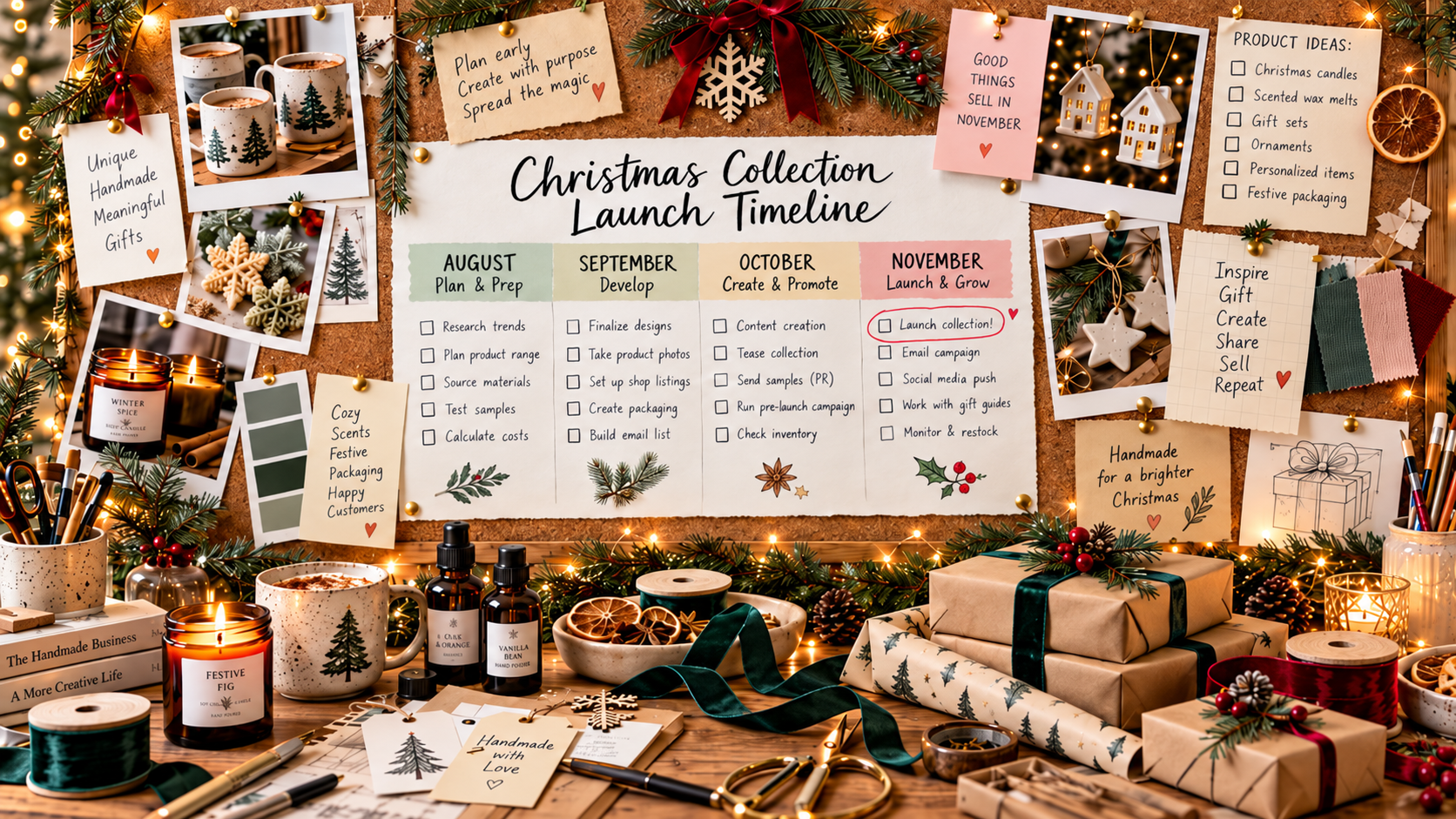
A Simple Christmas Launch Timeline
If you’re looking for a starting point, here’s a simple schedule you can adjust for your own business:
August–September
Choose fragrances, order supplies, begin testing, decide on packaging, and plan your collection.
September–Early October
Finish testing, begin production, photograph products, write descriptions, and start teasing the collection.
October
Launch your main Christmas collection and begin regular holiday promotion.
November
Restock best sellers, introduce gift sets and bundles, attend holiday markets, and promote heavily.
December
Focus on ready-to-ship items, last-minute gifts, stocking stuffers, shipping deadlines, and winter-friendly products.
This isn’t a rulebook.
It’s simply a framework you can move earlier or later depending on what you make and how your business operates.
So… How Early Should You Launch?
For many makers, October is a fantastic target.
September can be great for early launches, wholesale orders, teasers, and customers who shop ahead.
November still gives you plenty of opportunity.
And even December can be productive if you focus on products customers can receive in time and gifts they still need.
More important than choosing the “perfect” date is giving yourself enough time to make, test, photograph, list, promote, package, and ship your products without turning the entire holiday season into one giant emergency.
Your Christmas collection should be exciting for your customers.
And ideally, it should still be a little exciting for you, too.
Plan early enough to give yourself some breathing room, launch when your business is ready, and remember: you don’t have to do everything at once to have a successful holiday season.