











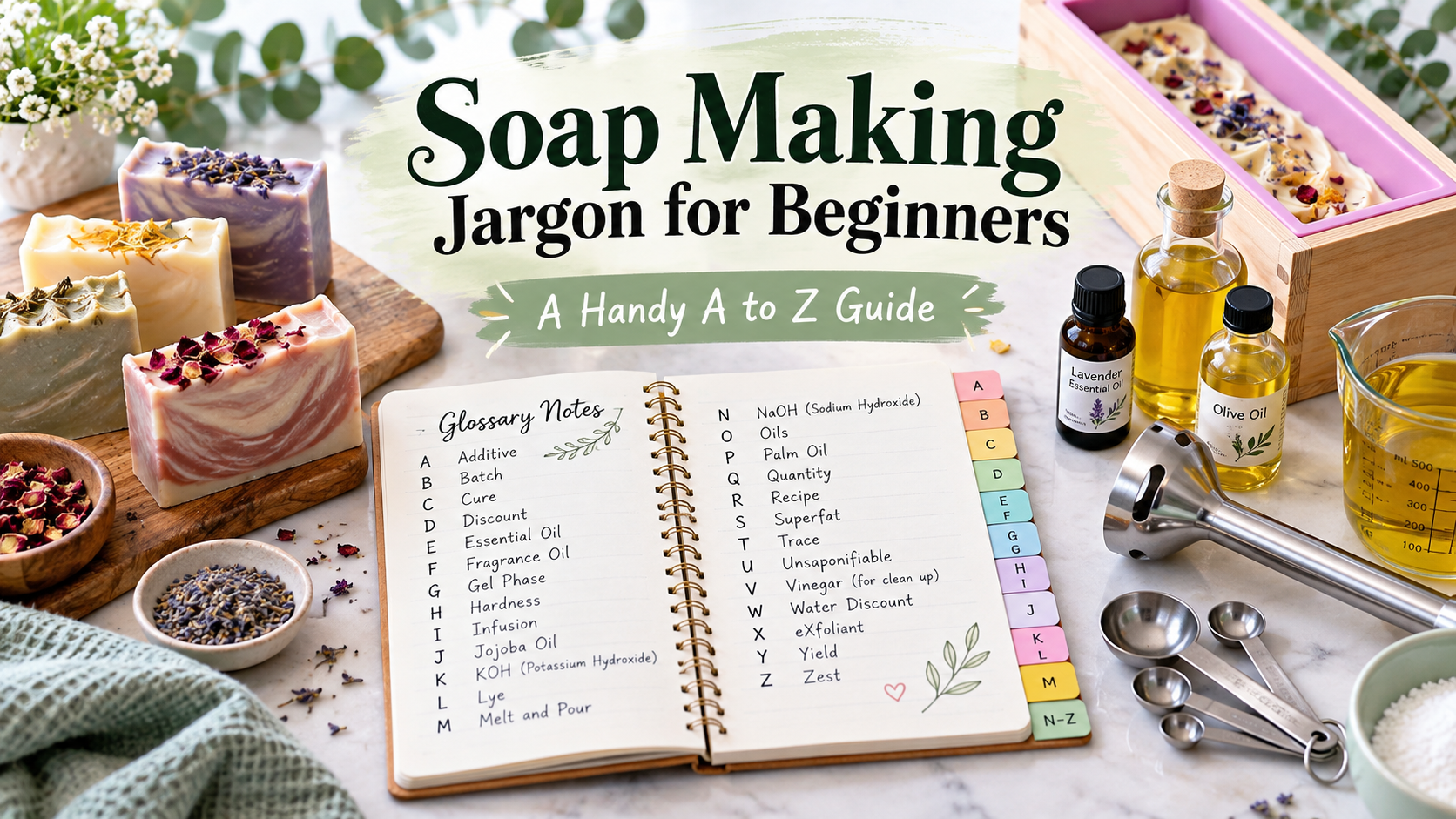
Soap Making Jargon for Beginners: Our Handy A–Z Guide
If you’re new to soap making, you may feel like you’ve stepped into a whole new language.
Trace. Superfat. Gel phase. DOS. SAP value. Seizing. Water discount.
Wait… what?
Don’t worry. Soap makers use a lot of words, abbreviations, and phrases that sound complicated at first but become second nature once you understand what they mean.
This beginner-friendly glossary covers many of the common terms you’ll see in soap recipes, Facebook groups, tutorials, supplier websites, and conversations with other makers.
Think of it as your soap-making cheat sheet.
A
Accelerate / Acceleration
When soap batter thickens more quickly than expected after fragrance oil, essential oil, additives, or another ingredient is added.
A fragrance that is described as accelerating trace may give you less working time for complicated swirls or layered designs.
Additives
Ingredients added to soap for appearance, texture, marketing appeal, or other characteristics.
Common additives include clays, oatmeal, poppy seeds, activated charcoal, botanicals, sugar, salt, milk powders, and colorants.
Alkali
A strongly basic substance used in soap making.
In handmade soap, the alkali is usually sodium hydroxide for bar soap or potassium hydroxide for liquid soap.
Ash / Soda Ash
A harmless white or powdery-looking film that sometimes develops on the surface of cold process soap.
Soda ash usually affects appearance rather than the usability of the soap.
B
Batch
One complete quantity of soap made from a single recipe. If you mix enough soap batter to fill one loaf mold, for example, that would generally be considered one batch.
Batter
The mixture of oils, fats, lye solution, and other ingredients after the soap-making process has begun. Before it hardens into bars, makers often simply call it soap batter.
Base Oils
The main oils and fats used to create a soap recipe. Examples include olive oil, coconut oil, palm oil, rice bran oil, avocado oil, sweet almond oil, and castor oil.
Different oils contribute different qualities to the finished soap.
Bastile Soap
A soap made primarily with olive oil but containing other oils as well. It is similar to Castile soap but is not made exclusively from olive oil.
Bloom
When certain powdered ingredients or colorants are mixed with a small amount of liquid before being added to soap. This can help prevent clumps and improve dispersion.
C
Castile Soap
Traditionally, a soap made with 100% olive oil. Today, the term is sometimes used more loosely commercially, so always check the actual ingredient list.
Caustic
A word used to describe substances such as sodium hydroxide that can chemically burn skin and other materials. Lye must always be handled with appropriate safety precautions.
Cold Process Soap
Soap made by combining oils or fats with a lye solution and allowing the chemical reaction of saponification to take place.
Cold process soap normally requires several weeks of curing before use.
Colorant
An ingredient used to give soap color. Common soap colorants include micas, oxides, ultramarines, clays, charcoal, and certain botanical powders.
Not every colorant is appropriate for every type of soap, so makers should verify that a colorant is suitable for their intended application.
Cure / Curing
The period after cold process soap is unmolded and cut when it is allowed to sit in a well-ventilated area.
During curing, excess water evaporates and the bar becomes harder and longer lasting. A common cure time is around four to six weeks, although the ideal time depends on the recipe.
D
Discount
Reducing the amount of a particular ingredient from a calculated amount. You may hear makers talk about a water discount or occasionally a lye discount.
DOS
Short for Dreaded Orange Spots.
These are orange or brownish spots that can appear on handmade soap and are commonly associated with oxidation or rancidity. Possible contributing factors may include older oils, storage conditions, humidity, or certain ingredients.
Drop Swirl
A soap design created by pouring different colors of soap batter into a mold from varying heights or positions. The colors move through one another and create a swirled pattern inside the finished loaf.
E
Emulsion
The point where the oils and lye solution have successfully combined and are no longer separating. Soap batter can be emulsified before reaching a clearly visible trace.
Essential Oil
A concentrated aromatic material obtained from plants. Essential oils are different from fragrance oils and have their own usage considerations and maximum recommended amounts.
F
False Trace
When soap batter appears to have reached trace even though proper emulsification has not fully occurred. This can happen when harder fats begin cooling and solidifying during mixing.
Fatty Acids
Components of oils and fats that influence the characteristics of finished soap.
Common fatty acids discussed by soap makers include lauric acid, myristic acid, palmitic acid, stearic acid, oleic acid, linoleic acid, linolenic acid, and ricinoleic acid.
The fatty-acid profile of a recipe can help predict qualities such as hardness, cleansing, conditioning, and lather.
Fragrance Oil
A fragrance blend created for scenting products. Fragrance oils can contain natural and synthetic aromatic components.
Always check supplier documentation and recommended usage levels before using a fragrance oil in soap.
G
Gel Phase
A stage during saponification when soap becomes warmer and can temporarily look darker, shiny, or somewhat translucent. Soap that goes through gel phase may develop brighter or deeper colors.
Glycerin
A humectant naturally produced during the soap-making reaction. Handmade cold process soap naturally contains glycerin.
Glycerin Rivers
Translucent or slightly different-looking lines or streaks that may sometimes appear in cold process soap. They are generally cosmetic and do not mean the soap is unsafe.
H
Hard Oils
Oils or fats that are solid or semi-solid at room temperature. Examples may include coconut oil, palm oil, cocoa butter, shea butter, tallow, and lard.
They often contribute hardness and structure to a bar of soap.
Hot Process Soap
Soap that is heated during the soap-making process to speed up saponification. Hot process soap often has a more rustic appearance than cold process soap.
I
INS Number
A calculated number sometimes used by soap makers when evaluating a soap recipe. It is based on characteristics of the fats and oils in the formula.
While it can be useful as a general reference, it should not be treated as a guarantee of how a finished soap will perform.
In-the-Pot Swirl
A design technique where small portions of differently colored soap batter are poured back into the main soap pot and then poured into the mold.
K
KOH
The chemical abbreviation for potassium hydroxide. Potassium hydroxide is commonly used when making liquid soap and certain soft soaps.
L
Lather
The foam or bubbles created when soap is used with water.
Different oils affect the type of lather a soap produces. Some recipes create large fluffy bubbles, while others produce smaller, creamy bubbles.
Lye
A common soap-making term referring to strong alkalis used in saponification.
For handmade bar soap, this normally means sodium hydroxide. For liquid soap, potassium hydroxide is commonly used.
Lye Concentration
The ratio or percentage of lye compared with the amount of liquid in a lye solution. Changing the concentration can affect how quickly soap batter thickens and how much water must evaporate during curing.
Lye Discount
Using slightly less lye than the theoretical amount required to fully react with all the oils in the recipe. In practice, this concept is closely related to superfatting.
Lye Heavy
Soap containing too much unreacted lye. Lye-heavy soap can be irritating or unsafe to use and should not be sold or used as normal finished soap.
Lye Solution
A mixture of lye and water or another suitable liquid used in soap making.
Always add lye to the liquid — never pour liquid onto dry lye.
M
Mica
A popular powdered colorant used in soap and other handmade products.
Not every mica behaves the same way in cold process soap because the high-pH environment can change certain colors.
Mold
The container into which soap batter is poured so it can harden into a particular shape. Common molds include loaf molds, slab molds, individual cavity molds, and silicone molds.
N
NaOH
The chemical abbreviation for sodium hydroxide. This is the type of lye most commonly used for making solid bar soap.
Natural Soap
A broad marketing phrase rather than one single universally defined soap-making formula.
Because the word natural can have different meanings depending on the context, makers should be careful about how they use the term when describing products.
O
Oil Discoloration
A color change caused by certain oils, fragrances, additives, or ingredients. Fragrance oils containing vanilla or vanillin, for example, can cause soap to turn tan or brown.
Overheating
When soap becomes excessively hot during saponification.
Signs can include cracking, expanding, bubbling, or forming a raised center. Milk soaps, sugar-containing recipes, and some fragrances may generate additional heat.
P
pH
A scale used to describe how acidic or alkaline something is. True soap is naturally alkaline.
Pencil Line
A very thin layer of mica, charcoal, clay, or another powder placed between layers of soap. It creates a decorative line through the finished bar.
Piping
Decorating soap by placing thicker soap batter into a piping bag and applying it similarly to cake frosting.
Plop and Drop
A casual soap-making technique where thicker portions of colored soap batter are spooned or poured into a mold. This creates a more organic or random design.
Pomace Olive Oil
Olive oil produced using additional processing after the initial olive oil extraction. It is frequently used by soap makers because it can be economical and performs well in many soap recipes.
R
Rebatching
A process where previously made soap is shredded, grated, or chopped and then reheated with a small amount of liquid. It can be used to remake or modify an existing batch.
Ricing
When soap batter develops small grainy lumps that can resemble rice. This often occurs after adding certain fragrance oils.
Ricing does not always mean the batch is ruined. Sometimes continued mixing can bring the batter back together.
S
SAP Value
Short for saponification value.
It represents the amount of alkali needed to saponify a particular oil or fat. Because different oils require different amounts of lye, accurate soap recipes should be run through a trusted soap or lye calculator.
Saponification
The chemical reaction that happens when fats or oils react with an alkali such as sodium hydroxide.
The reaction produces soap and glycerin. This is the heart of soap making.
Seize / Seizing
When soap batter suddenly becomes extremely thick, sometimes almost solid.
Certain fragrance oils can contribute to seizing. A seized batch may resemble thick mashed potatoes or even become difficult to stir.
Separation
When oils and the lye mixture fail to remain properly combined. The mixture may visibly separate into layers.
Soap Dough
Soap formulated or prepared so that it remains soft and moldable for a period of time. Soap dough can be sculpted into decorative shapes.
Soap Calculator / Lye Calculator
A tool that calculates how much lye is required for the specific oils used in a soap recipe.
A good soap calculator can also provide information about water amounts, superfat levels, and estimated soap characteristics.
Soap on a Stick
A humorous soap-making phrase describing extremely fast seizing.
The batter becomes so thick so quickly that it seems to solidify around the mixing utensil.
Soft Oils
Oils that are liquid at room temperature. Examples include olive oil, sunflower oil, rice bran oil, avocado oil, and sweet almond oil.
They often contribute conditioning qualities to soap.
Stick Blender
A handheld immersion blender commonly used to mix oils and lye solution. A stick blender greatly speeds up emulsification compared with stirring entirely by hand.
Superfat
The percentage of oils in a soap recipe intentionally left unsaponified.
For example, a soap recipe with a 5% superfat is calculated so that a small portion of oils remains after saponification.
Superfat levels must be selected carefully because extremely high levels can affect the bar’s performance and shelf life.
Swirl
A decorative soap-making technique that combines multiple colors or portions of soap batter into patterns.
Common techniques include drop swirls, in-the-pot swirls, hanger swirls, Taiwan swirls, spoon swirls, column pours, and peacock swirls.
T
Tallow
Rendered animal fat, usually from cattle, that can be used as a soap-making fat. Tallow contributes hardness and a creamy lather.
Temperatures
Soap makers often discuss the temperature of their oils and lye solution before mixing.
There is no single perfect temperature for every recipe. The ideal temperature can depend on the oils, additives, fragrance, desired design, and soap-making method.
Trace
The stage where the oils and lye solution have emulsified and the soap batter begins to thicken.
Light trace: Thin batter with only slight thickening.
Medium trace: Noticeably thicker but still pourable.
Thick trace: Heavy batter that holds its shape more clearly.
For detailed swirls, makers often work at emulsion or light trace.
Titanium Dioxide
A white pigment frequently used to lighten or whiten soap. It is commonly abbreviated as TD.
U
Unmold
Removing hardened soap from its mold. The amount of time before unmolding depends on the recipe, mold, temperature, water content, and other factors.
V
Vanillin
One of the aromatic components associated with vanilla.
Fragrance oils containing vanillin may discolor cold process soap to cream, tan, brown, or very dark brown. Suppliers will sometimes provide a vanillin percentage to help makers anticipate discoloration.
Volcano
A dramatic overheating reaction where soap batter expands upward and may spill from the mold or container. It can resemble a miniature volcano — hence the name.
W
Water Discount
Using less water than a recipe or calculator’s default amount.
Reducing water can sometimes help soap harden sooner and may influence trace, gel phase, cure, and design time. Beginners should understand their soap calculator settings before making large water reductions.
Water-to-Lye Ratio
A way of expressing the relationship between water and lye in a soap recipe.
For example, a 2:1 water-to-lye ratio means two parts water are used for every one part lye by weight.
Z
Zap Test
A traditional soap-making method in which a tiny amount of soap is touched to the tongue to check for an electrical-like “zap” that may indicate unreacted lye.
Although experienced soap makers may discuss this method, beginners do not need to rely on it. Proper formulation, accurate weighing, appropriate processing, adequate cure time, and other testing methods are safer and more useful habits to develop.
Common Soap-Making Abbreviations
CP — Cold Process
HP — Hot Process
MP — Melt and Pour
FO — Fragrance Oil
EO — Essential Oil
NaOH — Sodium Hydroxide
KOH — Potassium Hydroxide
SAP — Saponification Value
DOS — Dreaded Orange Spots
TD — Titanium Dioxide
SF — Superfat
A Few Phrases You’ll Hear Soap Makers Say
“It behaved beautifully.”
Usually means a fragrance or recipe gave the maker plenty of working time and did not cause major acceleration, ricing, seizing, or other problems.
“It moves fast.”
Usually means the soap batter thickens quickly.
“It discolors.”
Usually refers to a fragrance or ingredient changing the color of the finished soap.
“It went straight to thick trace.”
The batter thickened much faster than expected.
“I soaped cool.”
The maker worked with relatively lower-temperature oils and lye solution.
“I soaped warm.”
The maker worked with warmer oils and lye solution.
“It overheated.”
The soap became hotter than the maker intended during saponification.
“I forced gel.”
The maker intentionally kept the soap warm enough to encourage gel phase.
“I prevented gel.”
The maker intentionally kept the soap cooler in an attempt to avoid gel phase.
“It set up quickly.”
The soap became firm or thick faster than expected.
“It unmolded cleanly.”
The soap came out of the mold without sticking, tearing, or leaving large portions behind.
One More Term Every New Soap Maker Should Know: Testing
Every new soap recipe, fragrance, colorant, additive, and ingredient combination should be tested before being produced or sold on a larger scale.
Fragrance oils can behave differently from one soap formula to another. A scent that works beautifully in one recipe may accelerate, discolor, or behave differently in another.
Small test batches can save a lot of ingredients — and frustration.
Don’t Let the Lingo Scare You
Nobody starts soap making knowing all of these terms.
The first time someone tells you their fragrance riced at light trace before going into gel phase, it may sound completely ridiculous.
A few batches later?
You’ll know exactly what they mean.
Save this guide, come back whenever you run into an unfamiliar term, and before long you’ll be speaking soap-maker language right along with everyone else.
And remember: learning the terminology is helpful, but successful soap making comes from good formulas, accurate measurements, proper safety practices, careful testing, and experience.
See Also
Why Did My Soap Do THAT?
A maker-friendly guide to some of the most common soap-making surprises, including acceleration, discoloration, overheating, partial gel, scent changes, and more.
Lye and Soap Making: A Friendly Guide for Makers
Learn what lye does in soap making, why it is necessary, and the important safety basics every new soap maker should understand.