

















Stop Underpricing Your Handmade Products!
Because your time, talent, and hard work deserve more than just breaking even.
You've spent hours perfecting your candle recipe, experimenting with fragrance blends, creating gorgeous soap designs, or whipping up the perfect body butter.
You've tested, tweaked, poured, mixed, packaged, labeled, and probably made a few mistakes along the way.
And now comes one of the trickiest parts of running a handmade business.
Deciding what to charge.
You look at your beautiful finished product and think, "Would someone really pay $20 for this?"
So you price it at $14 instead.
After all, you don't want to seem too expensive. You want customers to buy your products. And maybe the person at the next craft show is selling something similar for less.
Sound familiar?
Here's something every handmade business owner needs to hear:
You can love what you do and still deserve to make money doing it.
Let's talk about how to stop underpricing your handmade products, understand what they're really costing you, and build a pricing strategy that helps your business grow.
1. The Hidden Cost of Being a Maker
One of the biggest pricing mistakes handmade business owners make is counting the obvious expenses while forgetting everything else.
Let's say you're making scented candles.
You probably know how much you paid for your wax, fragrance oil, wicks, and jars.
But what about everything that happens between opening those supplies and handing a finished candle to a customer?
Think about it.
- The labels you print or purchase
- The boxes, tissue paper, and packaging supplies
- The time spent melting, pouring, cleaning, and labeling
- The electricity used during production
- Equipment that eventually needs replacing
- Website subscriptions and payment processing fees
- Craft show fees and marketing expenses
- Supplies wasted during testing or unsuccessful batches
And here's the really big one.
Your time.
Somewhere along the way, many makers start treating their time as though it doesn't cost anything.
But it does.
Even if you're making products at your kitchen table while watching your favorite television show, your time still has value.
You wouldn't expect someone else to spend hours working for free.
So why expect that of yourself?
2. Stop Confusing Sales With Profit
Here's a little scenario.
You've had a wonderful Saturday at a craft show. Customers loved your products, you sold $500 worth of merchandise, and you're feeling pretty good.
That's exciting!
But before you celebrate that $500 as money earned, consider what it actually cost you to make those sales.
You purchased supplies. You spent time making the products. You paid for your booth. You traveled to the event, set up your display, and spent the day selling.
That $500 is your revenue, not your profit.
Your profit is what's left after accounting for the costs of earning that revenue, including the labor you've assigned to making your products.
And if you haven't been tracking those costs?
You might be working much harder than you realize for a surprisingly small return.
A busy business isn't necessarily a profitable business.
That's why understanding your numbers matters just as much as making wonderful products.
3. Let's Figure Out What Your Products Really Cost
Don't worry. We're not turning this into an accounting class!
We're going to keep things simple.
For each product you make, start with four basic categories:
Materials: Everything that physically goes into the product, including fragrance oil, wax, soap base, oils, butters, additives, and colorants.
Packaging: Your containers, lids, labels, wraps, boxes, and other packaging used for each product.
Labor: The time you spend making and preparing the product, multiplied by an hourly rate you choose for your work.
Overhead: A reasonable portion of the expenses required to operate your business, such as utilities, equipment, insurance, subscriptions, and other ongoing costs.
Once you know those costs, you can begin determining a selling price that also allows room for transaction fees and profit.
A Real-World Example: Pricing a Handmade Candle
Let's pretend you're making a beautiful scented candle in a decorative jar.
Here are some hypothetical costs for one finished candle.
| Expense | Cost |
|---|---|
| Wax, fragrance oil, and wick | $4.50 |
| Jar, lid, label, and packaging | $1.50 |
| Labor | $4.00 |
| Allocated overhead | $1.00 |
| Total base cost | $11.00 |
Now imagine you decide to sell that candle for $14.
If your selling and payment fees total 5% of the selling price, that's another $0.70.
You're left with $2.30 in profit after your base costs, assigned labor, and those fees.
That's not much room for unexpected expenses, discounts, or growing your business.
What happens if you sell that exact same candle for $20?
Profit Comparison Per Candle
Based on $11 in base costs, including assigned labor, and 5% selling fees. Profit shown is before income taxes and any costs not included in the example.
At $20, with $1 in selling fees, you'd have $8 remaining as profit per candle.
That is a significant difference!
Of course, this doesn't automatically mean $20 is the right price for every candle. Your market, product quality, competitors, customers, and sales channels all matter.
But it demonstrates why knowing your true costs is so important.
These figures are examples, not suggested market prices or guaranteed profit margins.
4. Give Yourself Permission to Charge for Your Time
This deserves its own conversation because it's where so many handmade business owners get stuck.
Maybe you started making candles because it was relaxing.
Maybe you fell in love with soap making and wanted to share your creations with friends.
Maybe you began making bath products as gifts, and people started asking if they could buy them.
That's how many wonderful handmade businesses begin!
But there's a difference between enjoying a hobby and operating a business.
When you're selling products, your time becomes part of your production cost.
Here's an easy way to calculate it:
Total Active Production Hours × Hourly Rate
÷
Number of Finished Products
For example, imagine you spend two hours actively making, finishing, and packaging 12 candles.
If you assign yourself an hourly rate of $24:
- Two hours of labor equals $48.
- You produced 12 candles.
- Your labor cost is $4 per candle.
See? Not so complicated!
The key is to include all the active work, not just the pouring or mixing. Setup, cleanup, cutting, labeling, and packing count, too.
You don't necessarily need to count passive curing or cooling time as though you were actively working, but you do need to consider how it affects your production capacity.
And remember, accounting for your labor isn't the same thing as making a profit. Your labor compensates you for work performed. Business profit is what remains after expenses and gives your business room to grow.
5. The Problem With Pricing Based on What Everyone Else Charges
We've all done it.
You find another business selling a similar candle, soap, or wax melt, and you immediately start comparing prices.
"They're charging $12. Maybe I should charge $11."
But here's the problem.
You don't know their costs.
Maybe they purchase supplies in much larger quantities.
Maybe their containers cost half as much as yours.
Maybe they produce hundreds of products at once, making their labor cost per item much lower.
Or maybe they're underpricing their products, too!
Looking at competitors is useful. It helps you understand the market and what customers might expect.
But someone else's selling price shouldn't be the only thing determining yours.
Your price needs to make sense for your business.
6. A Simple Formula for Setting Your Prices
Once you know your base cost, you can work toward a selling price that includes your desired profit.
Here's one way to do it:
(Base Product Cost + Fixed Selling Fees)
÷
(1 − Percentage Selling Fees − Target Profit Margin)
For example, suppose your base cost is $10, your percentage-based selling fees are 5%, and you'd like a 30% profit margin, before income taxes.
Your calculation would be:
$10 ÷ (1 − 0.05 − 0.30) = $15.38
This gives you a starting price that covers the costs you've included, allows for those fees, and leaves approximately 30% of the selling price as profit.
Don't confuse markup with profit margin, either.
Markup measures how much you add to your costs. Profit margin measures how much of your selling price remains as profit.
They're not the same thing!
And while you may have heard rules like "double your cost" or "multiply your materials by three," those shortcuts don't work equally well for every handmade product.
Use your actual numbers instead.
7. But What If Customers Think I'm Too Expensive?
This is probably one of the biggest fears handmade sellers have.
And it's understandable.
You work hard to earn every customer, and the last thing you want is to scare someone away with your prices.
But here's a little perspective.
Not everyone is going to be your customer, and that's okay.
Some shoppers are simply looking for the lowest price.
Others are looking for something unique, beautifully made, thoughtfully packaged, or produced by a small business they enjoy supporting.
Your job isn't necessarily to have the cheapest product.
It's to give the right customers a compelling reason to choose yours.
That might mean focusing on:
- Beautiful, consistent product photography
- Thoughtful and professional packaging
- Interesting fragrance combinations
- Excellent customer service
- Clear, accurate product descriptions
- A recognizable brand and memorable shopping experience
Rather than immediately lowering your prices, ask yourself whether you're communicating the value of your products clearly enough.
Customers can't appreciate details they don't know about!
8. Five Ways to Improve Profit Without Raising Every Price
Raising prices may sometimes be necessary, but it's not the only way to improve profitability.
1. Make Products in Batches
Producing several candles, soaps, or bath products during one session can reduce setup and cleanup time per item.
Just be sure your process remains safe and your product quality consistent.
2. Take a Closer Look at Packaging
Beautiful packaging matters, but expensive packaging doesn't automatically mean better packaging.
Could a simpler label look just as attractive? Could you find a less expensive box that still protects your products?
3. Review Your Supply Purchases
Purchasing larger quantities may lower unit costs, particularly for supplies you use regularly.
Just make sure you're not tying up money in excess inventory that could expire or sit unused.
4. Focus on Your Strongest Products
If you're maintaining 40 different fragrances but only 10 consistently sell well, it might be time to evaluate your lineup.
Too many slow-moving products can tie up money in ingredients, packaging, and finished inventory.
5. Consider Thoughtfully Designed Bundles
A coordinating candle and wax melt set, or a soap and body lotion pairing, may encourage larger purchases.
Just make sure the bundle price still covers every item's costs and leaves enough profit.
Small improvements can make a meaningful difference over time.
9. Don't Forget About Discounts and Sales
Everyone loves a good sale!
And promotions can be wonderful tools for encouraging purchases, introducing products, or moving seasonal inventory.
But discounts should be planned, not guessed.
Imagine you've priced a product at $20 and you're considering a 25% discount.
That brings the selling price down to $15.
Sounds reasonable, right?
But if your base cost is $11 and your selling fee is 5%, your profit drops from $8 at regular price to $3.25 at the discounted price.
That's a pretty big difference.
Before offering a discount, calculate what you'll actually earn.
A promotion that generates lots of orders but leaves very little profit may not be helping your business the way you hoped.
And remember, if you're considering wholesale pricing, you'll need to calculate that separately.
A wholesale discount isn't automatically profitable just because your retail price is.
10. What If You Need to Raise Your Prices?
First, don't panic.
Businesses review and adjust pricing all the time.
Your supply costs change. Packaging gets more expensive. Shipping and operating costs fluctuate.
It makes sense to review your prices periodically.
You don't necessarily need to make a major announcement every time a price changes.
But if you're making significant adjustments and want to explain them to your regular customers, keep your message simple and positive.
For example:
"We've made a few adjustments to our pricing to reflect the cost of materials and the care that goes into creating our handmade products. We're grateful for your continued support and look forward to bringing you more of the products you love."
You don't have to apologize for making thoughtful business decisions.
Your customers may appreciate the explanation, and the right pricing will help you continue serving them.
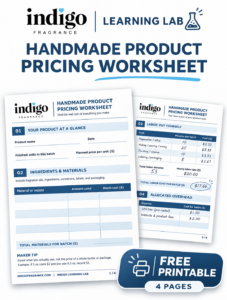
11. Your Handmade Product Pricing Worksheet
Ready to take a closer look at your own numbers?
Choose one product from your lineup and complete the following worksheet.
| Your Product Costs | Amount |
|---|---|
| Product name | __________ |
| Ingredients and materials | $________ |
| Packaging and labels | $________ |
| Labor cost per item | $________ |
| Allocated overhead | $________ |
| Additional per-item costs or waste allowance | $________ |
| Total base cost | $________ |
| Fixed selling fee per sale | $________ |
| Percentage-based selling fees | ________% |
| Desired profit margin | ________% |
| Calculated target selling price | $________ |
| Current selling price | $________ |
Use the formula from Section 6 to calculate your target selling price. The combined percentage-based selling fees and desired margin must be less than 100%.
Now ask yourself:
- Am I covering all my expenses?
- Have I included reasonable compensation for my time?
- What does my profit look like after selling fees?
- Does my price make sense for my target customers and market?
- Could I improve efficiency or reduce unnecessary costs?
- When did I last review this product's profitability?
Start with one product, then work through the rest of your collection.
You might be surprised by what you discover.
12. The Goal Isn't to Be the Cheapest. It's to Build Something That Lasts.
Here's something worth remembering.
You didn't start your handmade business just to spend your evenings pouring candles, making soap, filling jars, printing labels, and packing orders for barely enough money to replace your supplies.
You started because you enjoyed creating something.
Because you had an idea.
Because you wanted to share your products with other people.
And perhaps because you dreamed of turning something you loved into a business.
A sustainable handmade business needs more than sales. It needs enough money coming in to support the work behind those sales.
That doesn't mean every product needs a luxury price tag.
It doesn't mean charging more simply because something is handmade.
It means being intentional.
Knowing your numbers.
Understanding your costs.
And making pricing decisions based on facts rather than fear.
A Final Thought From Indigo Fragrance
We love seeing the creativity that goes into handmade candles, soaps, wax melts, and bath-and-body products.
Every finished creation represents decisions, practice, patience, and effort that customers may never see.
As you continue growing your business, remember to give that work the attention it deserves when setting your prices.
You can care about your customers, offer wonderful products, and build a business that earns a healthy profit.
Those things can absolutely go together.
So the next time you're tempted to lower your price simply because you're afraid someone won't buy, take another look at your numbers first.
Your business deserves the opportunity to grow, and thoughtful pricing is one important part of making that happen.
Happy making and happy growing!
— Indigo Fragrance Learning Lab