












Fragrance Oils vs. Essential Oils: A Maker’s Guide
Choosing a scent is one of the best parts of making candles, soap, and bath and body products. It’s also where a few questions tend to pop up. What’s the difference between fragrance oils and essential oils? Is one better? And which one will help you create that scent you already have in mind?
Both have a place on a maker’s shelf. Understanding how they’re made and what they offer can help you choose the right one for your next creation.
Essential oils: scent from plants
Essential oils are concentrated aromatic extracts obtained from plants. Depending on the plant, that scent may come from its flowers, leaves, peel, wood, or other parts. Lavender, peppermint, and cedarwood are familiar examples.
Their aromas come from the plant itself. You can use a single essential oil or blend several together to create something more layered, such as an herbal, woodsy, or citrus-inspired scent.
The range of essential oils is tied to what plants can provide. So while you can build some beautiful blends, there’s no birthday cake tree to harvest.
Fragrance oils: a whole world of scent possibilities
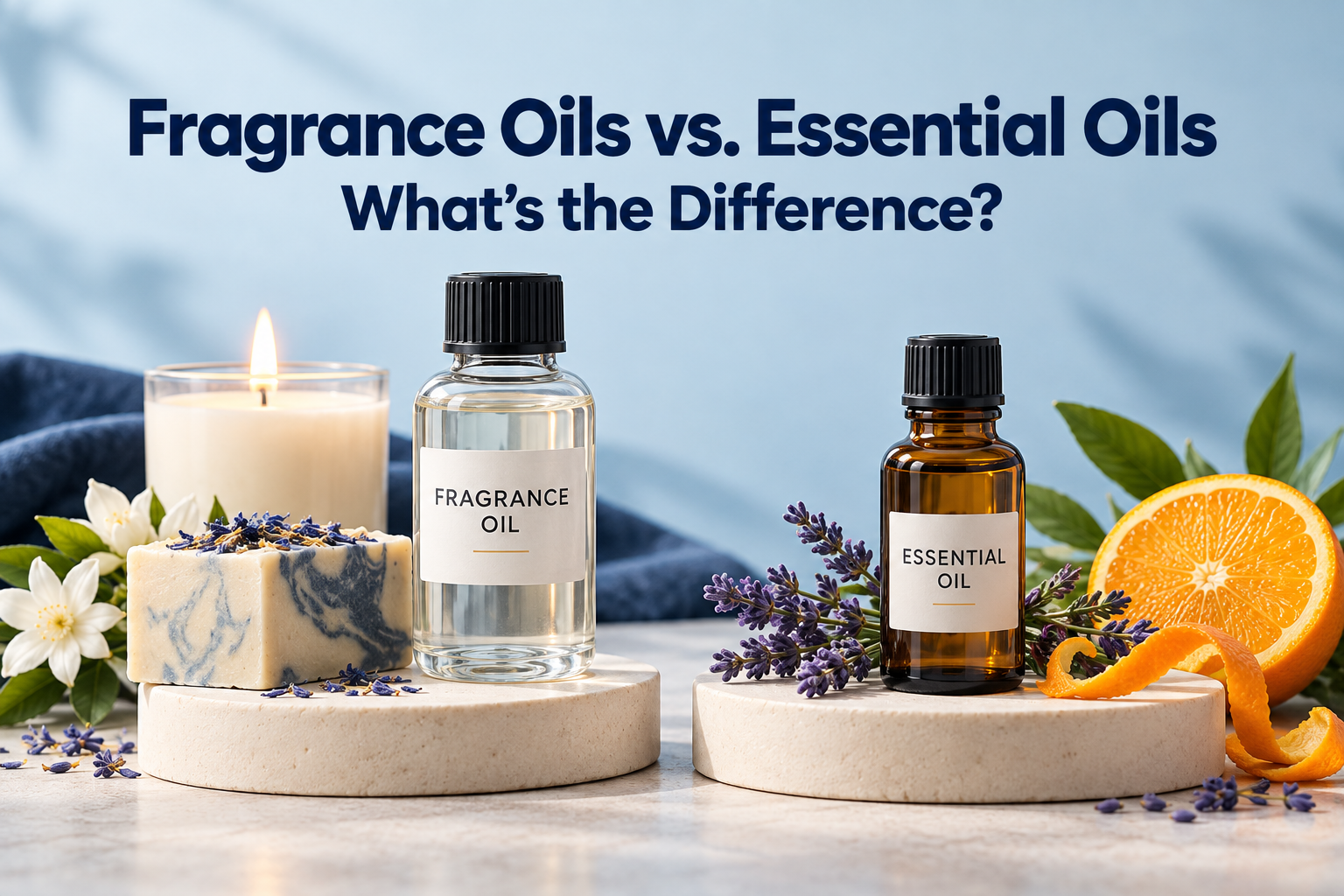
Fragrance oils are blends created to produce a particular scent. They can contain synthetic fragrance ingredients, ingredients from natural sources—including essential oils—or a combination of both.
Perfumers combine those ingredients to create everything from realistic florals and fresh fruits to warm bakery scents and complex, perfume-like blends. That gives makers room to dream up a candle that smells like a cozy cabin, a soap inspired by a tropical getaway, or a wax melt that brings back memories of Grandma’s kitchen.
Fragrance oils can also capture familiar plant aromas. A lavender fragrance oil and lavender essential oil may share a recognizable lavender character, but they aren’t the same ingredient. The fragrance oil might be designed to smell softer, sweeter, or more layered. Always read the description and product details so you know what you’re working with.
Is one better than the other?
That depends on what you’re making and the scent you want to achieve.
An essential oil can be a good fit when you want a particular botanical aroma and it works well in your formula. A fragrance oil gives you a broader range of scent styles, especially when your idea involves baked treats, fruity combinations, or an entire mood in a jar.
Neither label guarantees that an oil will smell stronger, last longer, or perform better in every product. The specific oil and your finished formula are what matter.
What does this mean for your next batch?
- Candles and wax melts: Choose an oil suitable for the application, follow your wax supplier’s guidance, and test it in your wax. For candles, evaluate both scent and burn performance. A lovely sniff from the bottle is just the beginning.
- Cold process soap: Look for testing notes about thickening, discoloration, and scent retention. Either type of oil can behave differently once it meets your soap recipe.
- Bath and body products: Check that the exact oil is suitable for the product you’re making. A scent used in a candle doesn’t automatically belong in a lotion, and different body products can have different usage limits.
Maker tip: Start small when trying a new scent. Keep notes on the amount you used, your formula, and how the finished product performed. Future you will appreciate the details—especially when that little test batch turns into a customer favorite.
A quick word about “natural” and safety
“Natural” tells you something about an ingredient’s origin, but it doesn’t guarantee that the ingredient is gentler or suitable for every use. Both essential oils and fragrance oils contain chemical compounds, and either can cause irritation or sensitivity for some people.
The helpful habit is the same for both: check the supplier’s directions and current safety information for your specific product. Follow applicable IFRA limits, which describe maximum concentrations for particular uses. Those limits are ceilings, rather than recommended amounts to aim for, and they don’t replace testing or assessing your finished product.
You don’t need to be intimidated by the paperwork. Think of it as another tool that helps you make informed choices, right alongside your scale and batch notes.
Choose the scent that fits your idea
There’s room for botanical blends, dessert-inspired fragrances, fresh everyday favorites, and scents that are a little unexpected. You can choose essential oils for one collection and fragrance oils for another, depending on your goals and your customers.
At Indigo Fragrance, we love seeing makers turn a scent into something of their own. Start with an idea, choose an oil that suits your project, and give yourself room to test and create. Your next favorite might be the one you haven’t poured yet.