












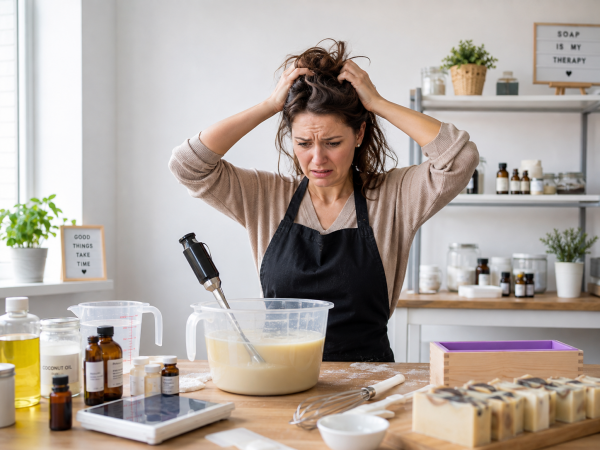
Why Did My Soap Do That?
A Maker-Friendly Guide to Common Soapmaking Surprises
If you’ve been making soap for any length of time, you already know one thing for sure: soap has a mind of it’s own.
One batch stays beautifully fluid. The next thickens before you can blink. A fragrance you adore may turn your creamy white soap to tan, while another gives you all the time in the world too create the perfect swirl.
That doesn’t necessarily mean you did anything wrong.
Soapmaking is chemistry, creativity, and a little bit of unpredictability all rolled into one. Understanding why certain things happen can make troubleshooting easier—and help you feel much more confident with your next batch.
Here are some of the most common soapmaking surprises and what may be happening behind the scenes.
Your Soap Thickened Really Fast
You had your colors ready. Your mold was waiting. You added your fragrance and suddenly—
Hello, mashed potatoes.
This is commonly called acceleration, which simply means your soap batter begins reaching trace faster than expected.
Several things can contribute to acceleration, including:
- Certain fragrance oil components
- Higher soaping temperatures
- Some essential oils
- Particular additives
- Water amount
- Your recipe and fatty acid profile
- Mixing too much with the stick blender
Maker Tip
When working with a fragrance you haven’t used before, keep your design simple for the first batch. Once you know how the fragrance behaves, you can decide whether it gives you enough working time for layers, swirls, or more intricate techniques.
And remember: you don’t have to stick blend all the way to a thick trace. Sometimes less really is more.
Your Soap Changed Color
You poured a gorgeous creamy soap and came back later to find it beige, tan, or even deep brown.
One common reason? Vanillin.
Vanillin is an aromatic component frequently found in fragrances inspired by vanilla, bakery treats, caramel, chocolate, and other sweet or gourmand scents. Depending on the amount present, it can cause cold process soap to discolor over time.
And sometimes the fragrance name doesn’t tell the whole story. A fragrance that doesn’t have “vanilla” in its name may still contain components that contribute to discoloration.
Maker Tip
If discoloration is expected, make it part of the design!
Think:
- Chocolate brown and cream
- Caramel swirls
- Rustic layered soaps
- Dark bases with colorful accents
Sometimes what looks like a limitation can become part of what makes the finished bar beautiful.
Your Soap Has Tiny White Spots
Those little white specks can have several possible causes.
They may be related to ingredients that didn’t fully dissolve or incorporate, certain additives, temperature differences, or—in some cases—small areas of undissolved lye.
Because the causes can vary, don’t automatically assume every white spot means the same thing.
If you suspect there could be undissolved lye in the finished soap, it’s safest not to use the batch until you have determined what caused the spots.
Maker Tip
Careful measuring, thoroughly dissolving your lye, and properly incorporating additives can help prevent many batch surprises before they happen.
Your Soap Cracked Across the Top
A crack running across the top of a freshly poured loaf often means the soap became too hot.
Cold process soap naturally generates heat during saponification, and certain ingredients can encourage that temperature to climb even higher.
Fragrances, sugars, honey, milk, some additives, and heavy insulation can all contribute.
Maker Tip
Keep an eye on recipes containing ingredients that naturally increase heat. Depending on your formulation, you may want to use less insulation—or none at all.
A small crack may only be cosmetic, but it’s also your soap’s way of saying, Whew, things got a little warm in here.
Your Soap Has a Darker Circle in the Middle
Don’t panic.
Your soap may simply be going through gel phase.
During gel phase, the center of the soap heats up and becomes more translucent before cooling and hardening again. If only part of the loaf reaches gel phase, you may see a darker circle or oval in the middle after unmolding.
This is called partial gel.
It’s generally cosmetic and doesn’t automatically mean there’s anything wrong with your soap.
Maker Tip
Some makers intentionally encourage a full gel because they like the brighter colors and finished appearance. Others prefer to avoid gel altogether.
Neither method is automatically better. It’s simply another creative choice in your soapmaking process.
Your Soap Has Little Beads of Liquid on Top
Tiny droplets on freshly made soap can sometimes be caused by glycerin dew, particularly in melt-and-pour soap.
Glycerin is a humectant, meaning it attracts moisture. In humid conditions, that moisture can collect on the surface of the soap.
With cold process soap, surface liquid can have other causes, so take a closer look at the batch before deciding what you’re seeing.
Maker Tip
For melt-and-pour soap, wrapping finished bars once they have completely cooled can help protect them from humidity.
Your Fragrance Seems Different in Soap Than It Did in the Bottle
This one surprises a lot of newer makers.
A fragrance oil straight from the bottle is not always a perfect preview of how it will smell in a finished product.
Fragrance can smell different once it interacts with:
- Soap ingredients
- Heat
- The saponification process
- Other additives
- Time and curing
Some fragrance notes become softer. Others become more noticeable. Occasionally, a fragrance can change significantly from its out-of-bottle character.
That’s why testing matters.
Maker Tip
Don’t judge a fragrance oil solely by smelling it directly from the bottle.
Test it in the product you’re actually making and evaluate the finished result after the appropriate cure or resting time.
Your nose may thank you.
Your Soap Doesn’t Smell as Strong as You Expected
More fragrance isn’t automatically the answer.
Fragrance strength in finished soap can depend on the fragrance itself, your formulation, usage rate, cure time, and how individual fragrance components perform in soap.
Some notes naturally hold up better than others.
And most importantly, fragrance should always be used within the appropriate recommended usage level for the product you’re making.
Maker Tip
Keep notes from every batch.
Record things like:
- Fragrance used
- Usage percentage
- Recipe
- Temperatures
- Additives
- Trace behavior
- Discoloration
- Scent strength after curing
Your notebook can become one of the most valuable tools in your soapmaking space.
Test Small. Take Notes. Keep Making.
Soapmaking gets easier when you stop expecting every batch to behave exactly the same way.
Different oils, fragrances, additives, temperatures, techniques, and formulations can all affect your finished soap. The more you test, observe, and document, the better you’ll become at recognizing what your soap is telling you.
And remember: even experienced makers occasionally open a mold and say,
“Well…that wasn’t what I planned.”
That’s part of making.
At Indigo Fragrance, we’re proud to support makers at every stage—from that exciting first batch to the businesses producing hundreds of bars at a time. We believe great products start with quality ingredients, good information, plenty of testing, and makers who aren’t afraid to keep learning.
Keep creating. Keep experimenting. And most of all, enjoy the process.
Important: Always follow proper soapmaking safety practices and calculate your formulation carefully. Fragrance usage levels vary by fragrance and application. Refer to the applicable IFRA documentation and conduct your own testing before producing products for sale.